Himalayan Peak Difficulty Analyzer
Select a Peak
Click a mountain above to see its breakdown.
Expedition Profile
Primary Challenge
...
Why it's hard
...
There is a dangerous myth that you can just walk up any high mountain in India if you have enough stamina. The reality is far more brutal. When climbers ask, which is the hardest peak to climb in India, they are usually looking for a single name. But the answer depends entirely on how you define "hard." Are we talking about sheer altitude, where the air thins to a lethal degree? Or are we talking about technical difficulty, where one slip means a fatal fall down a vertical ice wall?
The Himalayas and the Karakoram range hold some of the most unforgiving terrain on Earth. To find the true hardest peaks, we have to look beyond the popular tourist trails and into the realm of expedition-grade alpinism. These mountains do not forgive mistakes. They demand respect, specific skills, and often, a bit of luck.
The King of Mountains: Why K2 is the Ultimate Challenge
If you want the undisputed title of the hardest mountain associated with the Indian subcontinent, you have to talk about K2. While politically located in Pakistan-administered Gilgit-Baltistan, K2 is culturally and geographically tied to the broader Himalayan/Karakoram system that defines mountaineering in this region. It stands at 8,611 meters (28,251 feet).
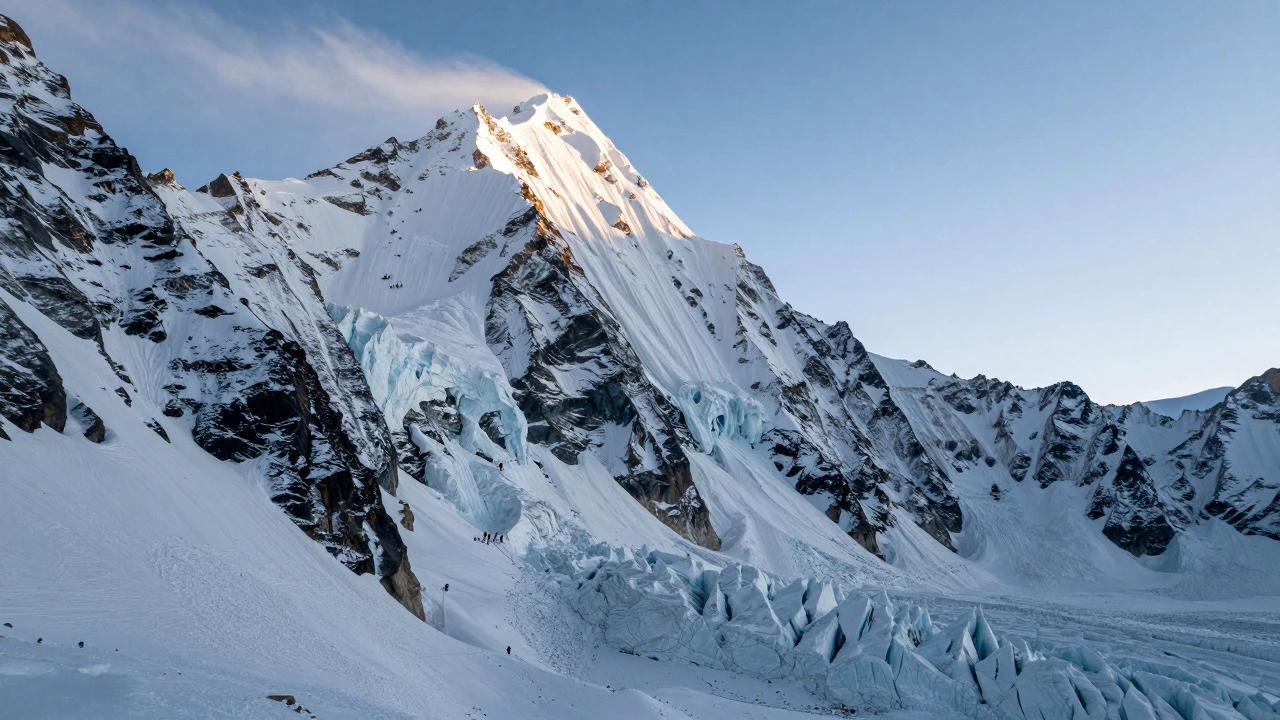
Mount Everest gets all the fame, but K2 earns its nickname, "The Savage Mountain," through blood. The fatality-to-summit ratio for K2 is roughly 25%, compared to Everest’s much lower percentage. Why is it so deadly? First, the angle. The entire mountain rises at a steep 45-degree pitch from base to summit. There are no gentle slopes to acclimatize on. You are climbing vertically almost from the start.
Second, the weather. K2 sits further north than Everest, making it colder and more prone to sudden, violent storms. The "Bottleneck," a narrow couloir beneath a massive serac (ice cliff), is a death trap. Climbers must pass through this bottleneck while hanging from ropes, exposed to falling ice blocks that can weigh tons. In 2008, an avalanche here killed 11 climbers in minutes. For pure technical difficulty combined with altitude, K2 remains the hardest challenge in the region.
The Technical Nightmare: Kamet and the Garhwal Himalayas
If K2 is the king of altitude and exposure, then Kamet is the master of technical complexity. Located in the Uttarakhand state of India, Kamet rises to 7,756 meters (25,446 feet). It was first climbed in 1931 by a British expedition led by Frank Smythe.
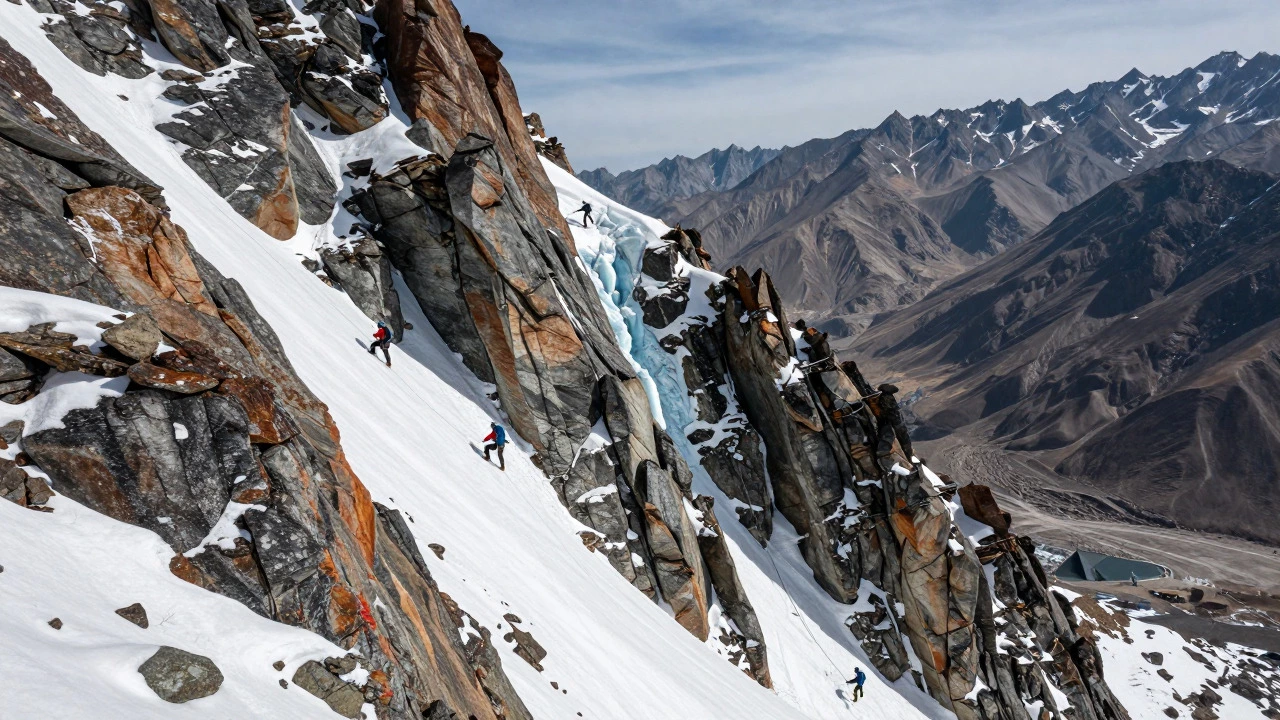
Why is Kamet considered harder than many 8,000-meter peaks? Because of the route. The standard route involves navigating complex rock and ice faces that require advanced alpine climbing skills. Unlike the crowded steps of Everest or even the Bottleneck of K2, Kamet offers fewer fixed lines and more objective hazards like rockfall and ice avalanches.
Climbing Kamet requires a team that can handle mixed climbing-switching between rock, snow, and ice seamlessly. The approach itself is grueling, involving days of trekking through remote valleys before you even see the mountain. The isolation adds a psychological layer of difficulty. If you get injured on Kamet, rescue is nearly impossible. This makes it a favorite among purists who value skill over logistics.
The Silent Killer: Nanda Devi and the Inner Sanctuary
Nanda Devi is unique. At 7,816 meters (25,643 feet), it is the highest peak entirely within India's borders. However, the real challenge isn't just the height; it's the geography. Nanda Devi is surrounded by a massive caldera known as the Inner Sanctuary, accessible only through two narrow passes: the East Col and the West Col.
This creates a logistical nightmare. You cannot easily retreat. Once you enter the sanctuary, you are trapped until the window closes. The weather inside the caldera is notoriously unpredictable. Winds can reach hurricane speeds without warning. The first ascent in 1936 by Eric Shipton and Tony Streather was a feat of endurance that took weeks longer than planned due to blocked routes.
For modern climbers, Nanda Devi is hard because of the commitment. You carry everything you need for weeks. There are no Sherpas waiting with supplies at Camp 2. You dig your own camps in frozen ground. The physical toll of hauling heavy loads up steep moraines and then tackling the final rock ridge makes it one of the most exhausting climbs in the Himalayas.
Other Peaks That Demand Respect
While K2, Kamet, and Nanda Devi top the list, other peaks offer their own brand of difficulty. Understanding these helps clarify what makes a mountain "hard."
| Peak Name | Elevation (m) | Primary Difficulty Factor | Technical Rating |
|---|---|---|---|
| K2 | 8,611 | Steepness, Weather, Ice Avalanches | Extreme (AD+) |
| Kamet | 7,756 | Mixed Rock/Ice, Isolation | Very Hard (D) |
| Nanda Devi | 7,816 | Logistics, Entrapment, Wind | Hard (AD) |
| Trisul | 7,120 | Vertical Rock Face, Exposure | Hard (D) |
| Satopanth | 7,075 | Glacial Travel, Altitude Sickness | Moderate-Hard (PD+) |
Trisul is another contender. Its main summit features a near-vertical rock face that requires serious rock climbing expertise. Many climbers fail not because of altitude, but because they lack the technical rock-climbing skills needed for the final push. It is a test of precision rather than brute force.
What Makes a Peak "Hardest"? Defining the Criteria
To truly answer which is the hardest, you must define the metric. Most beginners confuse altitude with difficulty. High altitude causes Hypoxia (oxygen starvation), which leads to decision-making errors. But technical difficulty is different.
- Objective Hazards: Risks outside your control, like avalanches, rockfalls, and lightning. K2 and Nanda Devi score high here.
- Technical Skill: The ability to climb steep rock or ice. Kamet and Trisul require higher grades of climbing proficiency.
- Logistical Complexity: How hard is it to get there and set up camp? Nanda Devi wins here due to its isolated nature.
- Weather Window: Some peaks have very short seasons. K2’s window is tiny, often just a few weeks in summer.
A peak can be technically easy but logistically impossible. Conversely, a peak can be technically simple but statistically deadly due to altitude. The "hardest" peak is the one that matches your weakest link. If you are a great climber but poor at logistics, Nanda Devi will break you. If you are strong but lack technical ice skills, Kamet will stop you.
Preparation: More Than Just Fitness
You cannot train for these mountains in a gym alone. Physical fitness is the baseline, but mental resilience is the key. Climbers who attempt these peaks spend years preparing. They climb smaller technical peaks first to build muscle memory. They learn to manage fear when standing on a ledge with a thousand-foot drop below them.
Equipment also plays a huge role. On K2, every gram counts. You need lightweight gear that performs in -40°C temperatures. On Kamet, you need durable crampons and axes that can handle mixed rock and ice. Choosing the wrong gear can turn a difficult climb into a fatal mistake.
Finally, there is the financial aspect. Expeditions to these peaks cost anywhere from $20,000 to $50,000 USD. This includes permits, porters, oxygen (if used), and guide services. The cost reflects the risk and the logistical effort required to support a team in such remote areas.
Final Thoughts on Conquering the Impossible
So, which is the hardest peak to climb in India? If you mean political India, Nanda Devi holds the crown for its combination of altitude, isolation, and logistical hell. If you include the broader Himalayan/Karakoram region associated with Indian mountaineering history, K2 is the ultimate boss level. It is the mountain that breaks the best climbers.
But remember, the goal isn't just to stand on top. It's to come back alive. These mountains teach humility. They remind us that nature is indifferent to our ambitions. Whether you choose K2, Kamet, or Nanda Devi, prepare as if your life depends on it. Because it does.
Is Mount Everest the hardest peak to climb in India?
No. While Everest is the highest, it is not the hardest technically. Its South Col route is well-established with fixed ropes and large support teams. K2 is widely considered harder due to its steepness, worse weather, and higher fatality rate. Additionally, Everest straddles Nepal and Tibet, not India.
Can a beginner climb K2 or Kamet?
Absolutely not. These peaks require advanced alpine experience. Beginners should start with lower-altitude treks in the Himalayas, such as the Valley of Flowers or Roopkund, before attempting technical climbs like Stok Kangri or Island Peak, and eventually work up to 7,000-meter peaks.
What is the best time to climb these peaks?
The primary climbing season is pre-monsoon, from May to June. Post-monsoon, September to October, is also possible for some peaks, but the windows are shorter and weather is less stable. K2 has a very narrow window, typically late July to August.
Do I need a permit to climb Nanda Devi?
Yes. Nanda Devi is part of a National Park and Biosphere Reserve. Climbing requires special permission from the Government of India, specifically the Ministry of Environment, Forest and Climate Change. Permits are strictly controlled to protect the fragile ecosystem.
How much does it cost to climb K2?
A full expedition to K2 can cost between $35,000 and $60,000 USD depending on the service level. This covers permits, logistics, food, oxygen, and guide support. Independent climbers may pay less for permits but still incur high costs for equipment and transport.
What skills are needed for technical peaks like Kamet?
You need proficiency in ice climbing, rock climbing, rope management, and crevasse rescue. Experience with mixed climbing (rock and ice) is crucial. Prior experience on 6,000-meter peaks is highly recommended to understand altitude sickness and cold-weather survival.
Is Nanda Devi safer than K2?
Statistically, yes, Nanda Devi has a lower fatality rate than K2. However, it is still extremely dangerous due to its isolation. Rescue options are limited, and the weather inside the caldera can be lethal. It is safer in terms of technical grade but harder in terms of logistics.
What is the difference between AD and D ratings?
These are French grading scales for difficulty. PD (Peu Difficile) means slightly difficult. AD (Assez Difficile) means fairly difficult. D (Difficile) means difficult. TD (Très Difficile) means very difficult. ED (Extrêmement Difficile) is extremely difficult. K2 routes are often rated ED or TD.